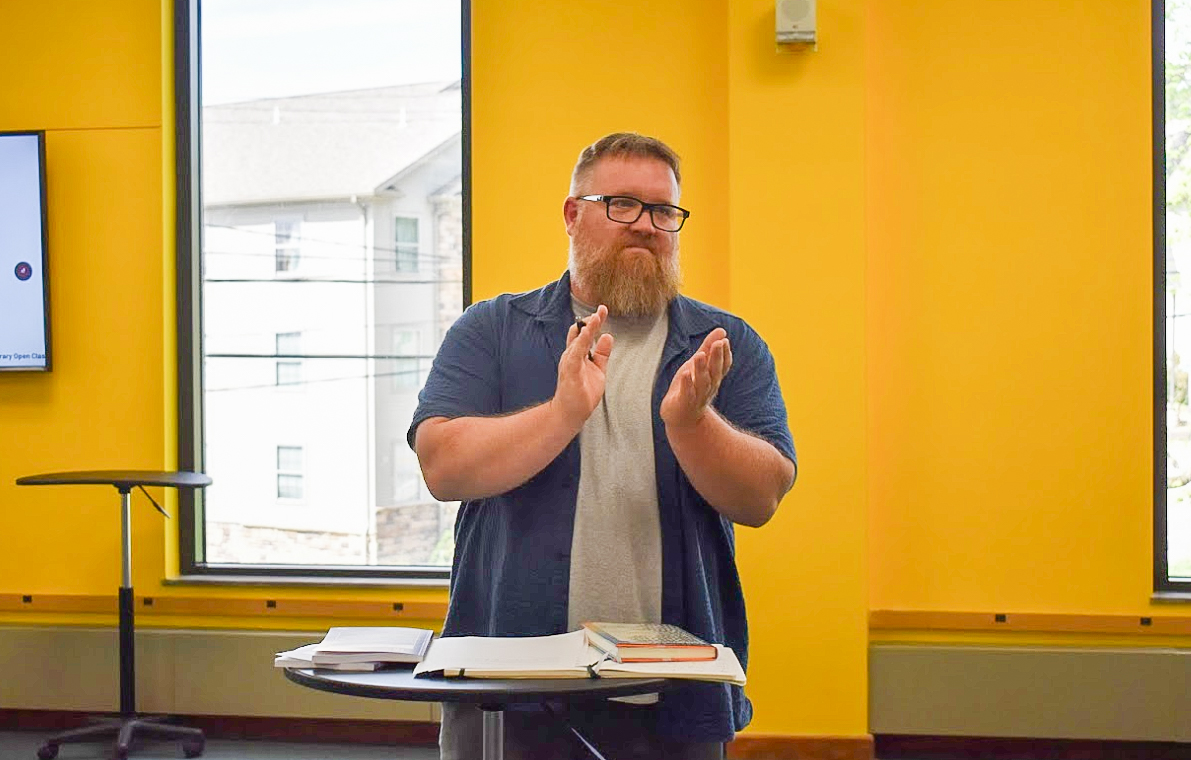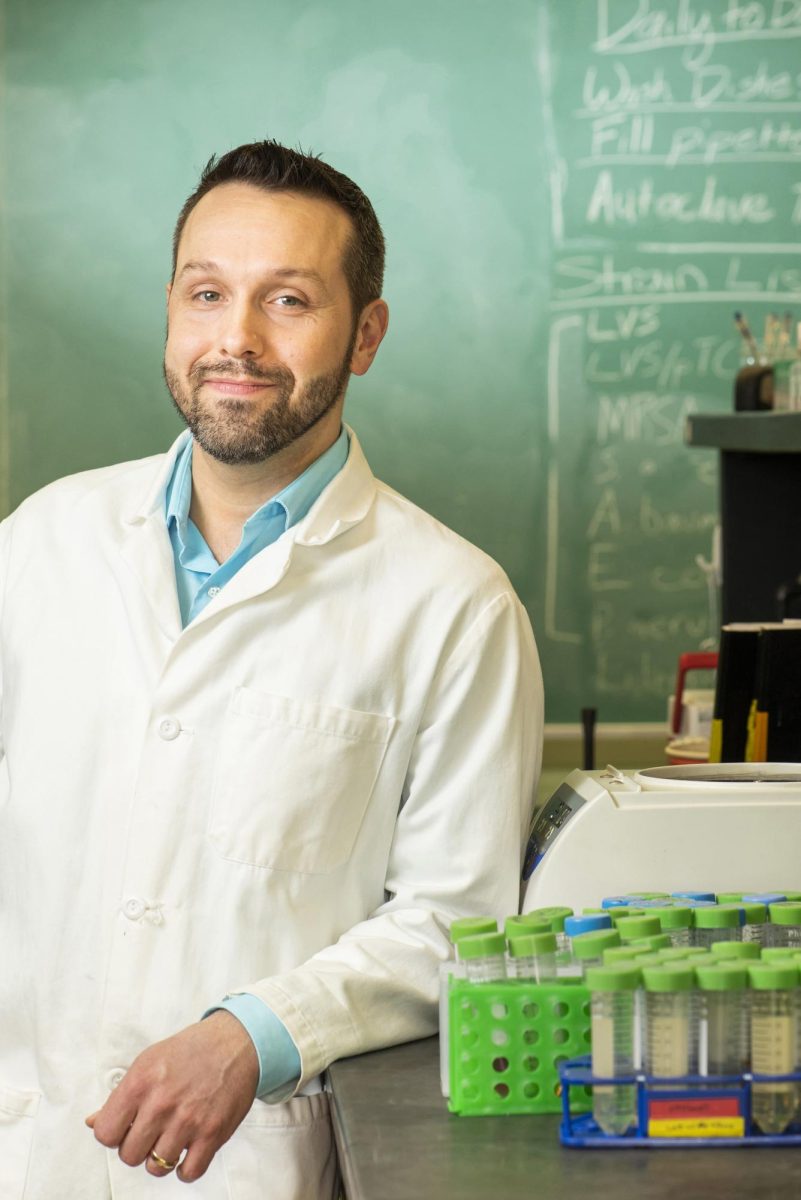
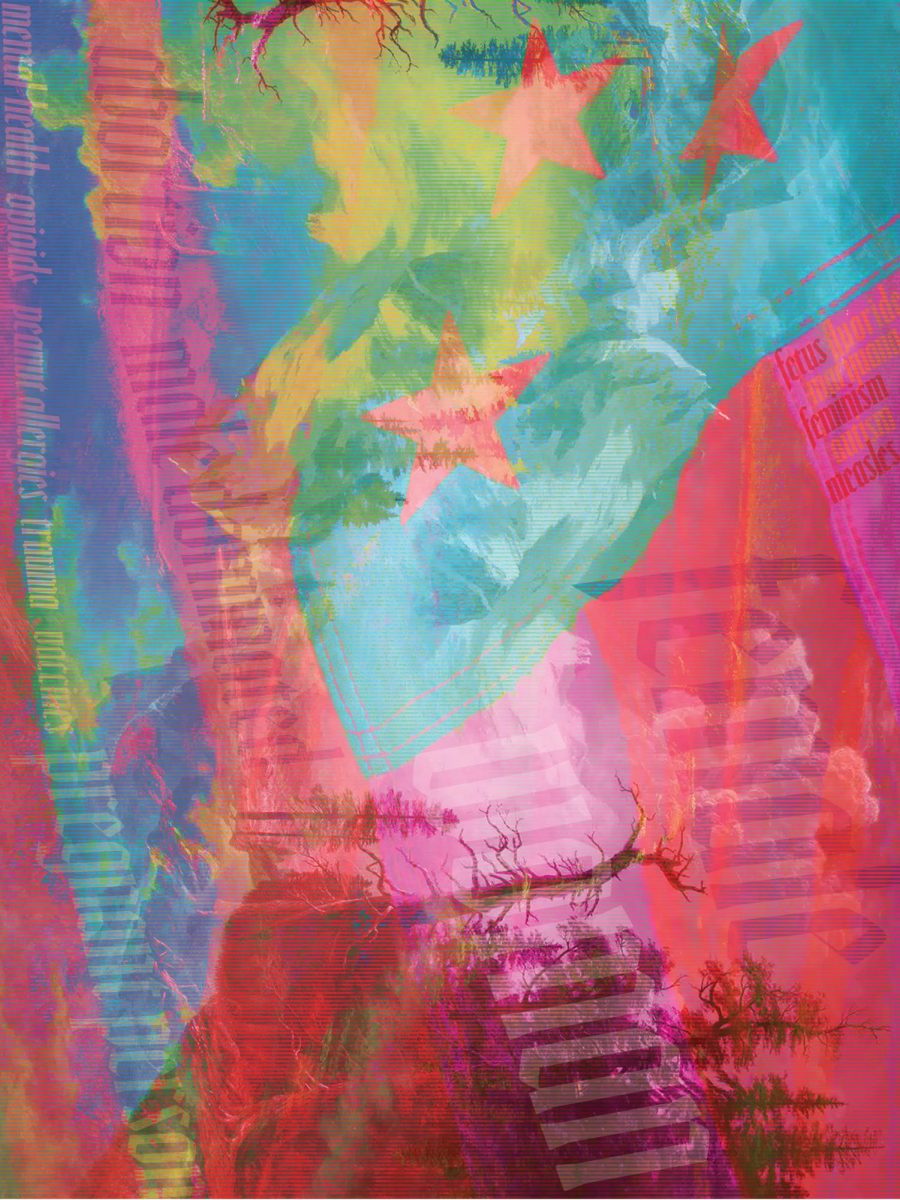
WEST LIBERTY, W. Va. –A student steps into Nutting Gallery on January 21 and the room feels charged. Sarah Davis’ barely legible text draws viewers in, asking them to slow down and look closer. Across the space, a chaotic grid of protest photography fills the wall as recorded chants echo through the gallery, breaking its expected quiet. Directly opposite, a large gold-framed painting presents Charlie Kirk wrapped in the American flag like a classical martyr. Nearby, Fencl’s cartoonish protesters and the Hamburglar’s head on a platter adds satire to the tension. Nothing in the room settles comfortably together, yet it works. At a university where professors are often expected to remain neutral, this exhibition suggests otherwise.
The framework began with Brian Fencl, Professor of Art and Director of the Nutting Gallery, who selected the theme American 250. After several years without a unifying concept, he felt one was due, and the nation’s 250th anniversary felt both timely and unavoidable.
Rather than shaping the show around a single message, Fencl focused on spatial dialogue. His role was placement, not ideological control. He hung his own work last, carefully spacing pieces so they would not overpower one another, even when they directly opposed each other across the room. The goal was conversation, not consensus.
“We should be able to do it without bullets involved,” he said. “Everybody’s grown-ups. We all know how to talk to each other.” More than anything, he hopes it inspires students to make the work they want to make.
Associate Professor of Graphic Design Sarah Davis begins with language and what happens when it disappears. After learning that hundreds of words were being removed from university websites, she kept hearing students say, “I feel like I don’t exist.” Her installation responds to that absence.
Referencing a list of roughly 350 banned or discouraged terms (see the full list here), she created posters that obscure rather than clarify. The words are barely legible, adjusted in transparency until they nearly vanish. Even the printing process became part of the struggle. She invites viewers to step closer and speak the words aloud.
“When a word is dying, the best way to give it life is to say it,” she said. “I’m literally asking people to do something some folks are not permitted to do.”
Layered beneath the text sit Hudson River School landscapes, once used to romanticize American grandeur. Flags are embedded in each piece. If language is political and speech is power, erasure begins with vocabulary; this becomes clear in her work.
Jared Thompson, Assistant Professor of Digital Media Design, approached American 250 from the present. Inspired by the anniversary, the political climate, and his own exposure to protests, he documented the Wheeling No Kings protest.
He shot nearly 3,000 photos, narrowed them to 400, and printed 50, one for each state. “America is loud,” he said. “I think it’s important that you are loud.”
The photographs are arranged in deliberate disorder, moved and rearranged until the wall felt restless rather than resolved. Thompson wanted visual movement, a sense that the eye could not settle. The anchor image, a protester holding a Cookie Monster sign reading “Trump no like cookies,” become the emotional center, using humor to cut through tension. The question beneath the layout remains: when does chaos become composition?
Sound completes the work. Thompson planned the audio while still at the protest, recognizing that chants and voices give demonstrations their force. He chose audio over video, allowing still images to breathe while the gallery fills with noise. Even visitors focused elsewhere cannot escape the sound. It bleeds across the room and refuses silence.
Jeff Grubbs, Professor of Art Education, began with shock. After hearing of Charlie Kirk’s murder, his response centered not on ideology, but on what it signaled for public speech. “Freedom of speech has to be protected,” Grubbs said. “We can’t be a better society if we can’t talk to one another.”
For him, the painting is less about one man and more about what happens when discourse becomes dangerous. “That could be any of us.”
Kirk is rendered with classical references, draped in a Greek toga and wrapped in the American flag like a contemporary martyr. The imagery echoes ancient Greece, where public debate shaped civic life. Grubbs sees universities as modern spaces for face-to-face exchange and worries that “we’re losing the ability to talk.” The traditional medium reinforces that continuity. He is not defending every argument. He is defending the space in which arguments can be made.
Each artist points forward.
A student leans closer, trying to read a nearly invisible word. Another stands silently in front of Charlie Kirk. Someone else laughs at the Burger King monument. The room holds disagreement without escalation. If America is turning 250, the faculty at West Liberty seem less interested in celebrating than in showing that even in disagreement, conversation is still possible, and that may be where hope begins.
BANNED WORDS LIST: https://pen.org/banned-words-list/